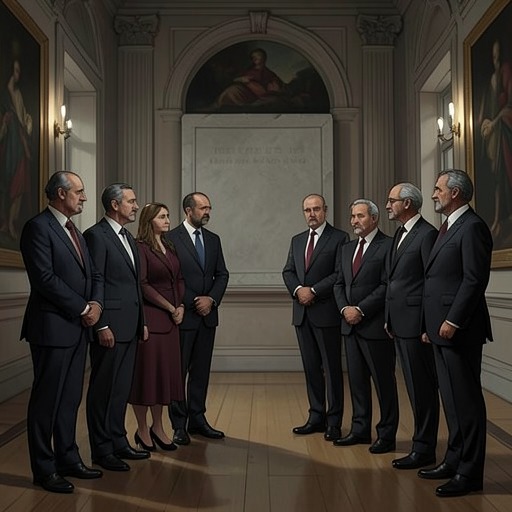
Alexander
The Glass Bead GameAlexander is the President of the Order, also called the Master of the Order, and a senior representative of Castalia’s meditative life. His relationship with Joseph Knecht joins institutional authority to personal affection: he refuses to release Knecht from office, but the refusal is not simply a bureaucratic verdict. The two men’s mutual regard gives their friendship a quiet warmth, even as Knecht’s growing desire to leave Castalia places that friendship under strain.
Identity and Office
Alexander had previously served as Meditation Master. Years earlier, during the first part of Knecht’s tenure as Master of the Glass Bead Game, the Order’s leaders assigned Alexander to watch over him. The former Meditation Master thus knew Knecht not only as a celebrated official but through the sustained, inward attention of his earlier charge.
After the previous President died, the Order elected Alexander as its new President. The succession brought a formerly latent friendship into a more visible working relationship: the two men now encountered one another often and had duties to perform together. Alexander’s authority, however, was not absolute. Constitutionally, the President held no superiority over the other Magisters. His standing came instead from the custom by which the Master of the Order presided over meetings of the Supreme Board, and from a tradition strengthened as the Order grew more meditative and monastic.
A Friendship at the Summit
During Alexander’s earlier daily oversight of Knecht, he became virtually Knecht’s father confessor and saw enough of his character and conduct to love him. Knecht, in turn, retained affectionate gratitude for Alexander as an exemplary representative of the hierarchical spirit. When Alexander became President and colleague, both men recognized the friendship that had been latent in their previous relationship.
Their closeness was expressed with restraint rather than through a shared private life. The narrative emphasizes that they lacked both the foundation of ordinary everyday tasks and the common experiences of youth. Their sympathy belonged instead to two colleagues at the summit of their respective vocations. It appeared in warmer greetings and farewells, in the ease of their mutual understanding, and sometimes in a few minutes of conversation during breaks in Board meetings. This limited form of intimacy matters: within a culture of hierarchy, even small gestures become personal signs of regard.
Alexander and Knecht also came to represent complementary values within the Castalian leadership. The ancient disciplines—grammar, astronomy, mathematics, and music—had been inherited from earlier intellectual traditions. In contrast, the Glass Bead Game and the discipline of the mind through meditation had become especially characteristic Castalian pursuits. As President and Master of the Game, Alexander and Knecht stood at the head of those two fields. Their friendship therefore offered a personal counterpart to the institutional ideal they embodied: the meditative and the intellectual could meet without rivalry.
Refusal and Sympathy
Knecht’s intention to depart from his office and the Province grew steadily stronger, beginning, by his own later reckoning, around the sixth or seventh year of his magistracy. Alexander’s friendship became one more tie binding him to the Castalian world, a counterweight to his urge to renounce his position and enter a different sphere of life. Yet the wish to leave continued to develop inexorably; affection did not dissolve the conflict between vocation within the hierarchy and the life Knecht felt called to pursue beyond it.
When Knecht petitioned for release from his office and transfer to a secular school system, the Board rejected the request. Its reply defended the principle that the Order assigned each person to a place: if members assessed their own aptitudes and chose their positions, the hierarchy itself would be at risk. The Board also objected to Knecht’s combining a professional communication with a personal petition. It urged him to continue administering the office entrusted to him, while acknowledging the admonitory force of his letter and expressing concern about his stated inability to conduct his duties.
The reply’s official style concealed, but did not entirely erase, its author’s individuality. Knecht read it closely and judged that its foundation was the hierarchical spirit, a sense of justice, and a love of order. He inferred that the rejection had been decided promptly and that the petition had been unwelcome, inconvenient, and troublesome. Yet he also detected sympathy in the mention of more lenient and friendly opinions voiced during the Board meeting. He had no doubt that Alexander had written the answer. The refusal therefore reveals both the strength of Alexander’s institutional obligations and the affection that softens, without overturning, their consequences for Knecht.
Meeting at the Turning Point
Alexander’s office becomes the setting for a more direct encounter after Knecht has been absorbed in reflections on awakening. Knecht has been considering awakening not as a simple advance toward abstract truth, but as an experience in which a person proves and discovers an attitude toward a concrete situation. Twilight is falling when a messenger, after knocking softly and waiting for Knecht to respond, leads him through the secretariat into the President’s office.
Alexander comes forward to meet him and apologizes that Knecht has arrived without warning and had to wait. He says he is eager to know what has brought Knecht there so suddenly, then adds that he hopes nothing bad has happened. Knecht laughs and reassures him that nothing bad has occurred, while asking whether Alexander truly has no idea why he has come. The exchange leaves the purpose of Knecht’s visit poised between them: what is clear is that he has come to Alexander personally, not merely to address an office. The scene gives their established mutual understanding a new test at the moment when Knecht’s departure from Castalia is no longer a remote inner prospect but an immediate matter for discussion.
Institutional and Religious Significance
Alexander’s importance extends beyond his private bond with Knecht. As President, he represents an authority whose power is defined less by constitutional superiority than by custom and accumulated spiritual prestige. His position has grown as the Order has become more meditative and monastic; within Castalia, the President and the Master of the Glass Bead Game increasingly stand as twin exponents of the Province’s distinctive spirit.
That spirit is both religious in force and deliberately without the foundations of a church. The Glass Bead Game can absorb the language of Christian theology alongside mathematics, music, and other disciplines, and for its most devoted players it can approach worship without developing a theology of its own. Alexander’s friendship with Knecht gives this institutional world a human face, while the rejected petition shows its limits: a hierarchy may cultivate meditation, sympathy, and a sense of vocation, yet still insist that its members remain in the places it assigns them. Alexander thus stands at the point where personal loyalty and the preservation of Castalian order meet, neither wholly cancelling the other.